Section 1: Sengoku Jidai, or Age of Battles
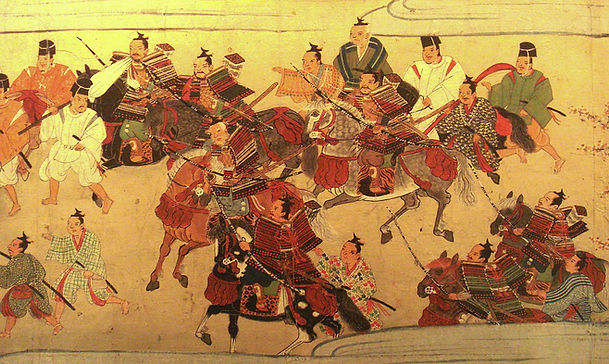
Muromachi Samurai, 1538 CE, Unknown Artist. (Musee Guimet, Paris; Courtesy of World History Encyclopedia)
In the first millennium, Japan was ruled by those who were considered divine Emperors, similar to how China and Korea were ruled at the time. The way politics were handled began to change in the late 12th century, moving in a far different direction than Japan’s neighbors, changing from an imperial rule to a military rule. The powerful samurai (warrior) class emerged from this political shift and slowly began to challenge the authority of the imperial court, leading to the emergence of the first shogunate in 1185 with Minamoto Yoritomo as the first shogun (military dictator) of Japan in 1192. This began a near seven century military rule, reducing the role of Emperor to simply a ceremonial figurehead instead of a powerful ruler. The prolonged era of military rule in Japan bred a distinct marital culture that set them apart from the rest of East Asia, however the two shogunates of the time, Kamakura and Ashikaga, could not control the whole of Japan. The Kamakura shogunate shared the power with the regional daimyo and the imperial court, while the Ashikaga shogunate was weaker and faced more challenges as the regions began to gain autonomy. Since the Shogun largely ignored the Emperor, the daimyo followed suit and began to ignore the shogunate authority, leading to a succession dispute that was widespread and bloody.
Citation:
Teekah, E. "Sengoku period." Encyclopedia Britannica, November 17, 2025. https://www.britannica.com/topic/Sengoku-period.
Section 1, Sidebar 1: The Daimyo

Japan’s First Shogun, or Military Commander, by the name of Minamoto no Yoritomo was the founder of the Kamakura shogunate. Courtesy of the Universal History Archive, Britannica, Wikipedia
Who were the Daimyo, and why were they warring? What was the purpose for the power grab that was happening at this time?
The Daimyo were Japanese warlords that ruled over most of Japan from their vast land holdings, and were typically subordinate to the shogun and marginally to the Emperor, ruling from about the 10th century (901 - 1000) to the middle of the 19th century (1801 - 1900). During the Sengoku Period (1467 - 1600 CE) the Onin War broke out, a war to determine who would become the next ruling shogun as the shogun had lost all control and power at the time. These Daimyos ruled hundreds of independent states in Japan, mostly consisting of other Daimyos, rebellious peasants that were upset with the way things were going, and Buddhist warrior monks. In this time, each independent state raised its own armies and made their own allies in order to fight this war and try to take the shogunate seat.
Citation:
Hartley, Victoria, and Thomas Connelie. "Japan in Chaos: Sengoku Period." ODU United Nations Society, Old Dominion University (2020).
Section 1, Sidebar 2: Samurai and the Samurai Code

Tsukioka Yoshitoshi (Japanese, 1839–1892), Inamura-Ga-Saki Moon at Daybreak,
Portfolio/Series: Tsuki hyakushi (One Hundred Aspects of the Moon)
月百姿. September 1886, Woodblock print; ink, color, embossing,
and burnishing on paper, Prints, Alexander H. Bullock Fund, 2002.195; Courtesy of Worcester Art Museum.
Who were the samurai and what was the samurai code?
The definition of the Samurai ideal changed constantly as Japan also changed ever rapidly, in both culture and politics, the romanticized image of the Samurai changed as needed in order to suit the historical narrative for Japanese national identity. The text to define the existence of the perceived warrior code was in the Kakuichi text, the more common and widely accepted version of the Heike monogatari, and in this text there were many different characters that would fully embody the romanticized warrior code. Along with that code comes the stipulation that every warrior must succumb to an honourable death, as this type of death is the solidification of the principles in which they believed in were more important than life itself, and this is the crucial aspect of the samurai mythos.
However, the warrior code was not something that was concrete, it was always in flux in accordance with whatever was happening at the time. The Ashikaga family took control in 1336, and at the time the land was infused with feudalistic values, but they could not control the land in the same way as before and it caused the country to spiral into civil war (Sengoku Jidai). During this period, the warrior code was changed and reinvented, and it was applied to the new social construct that was being built. Instead of the ideal warrior being something honorable and noble about their cause, the ideal warrior was one that was subservient to the laws of their house.
Citation:
Coldren, David A. "Literature of Bushidō: Loyalty, honorable death, and the evolution of the Samurai ideal." International ResearchScape Journal 1, no. 1 (2014): 2.