Dragons
by Delaynna Trim, Mabee-Gerrer Museum of Art Curator
Recently, I was researching a Chinese jade bowl. The bowl features two carved dragons.
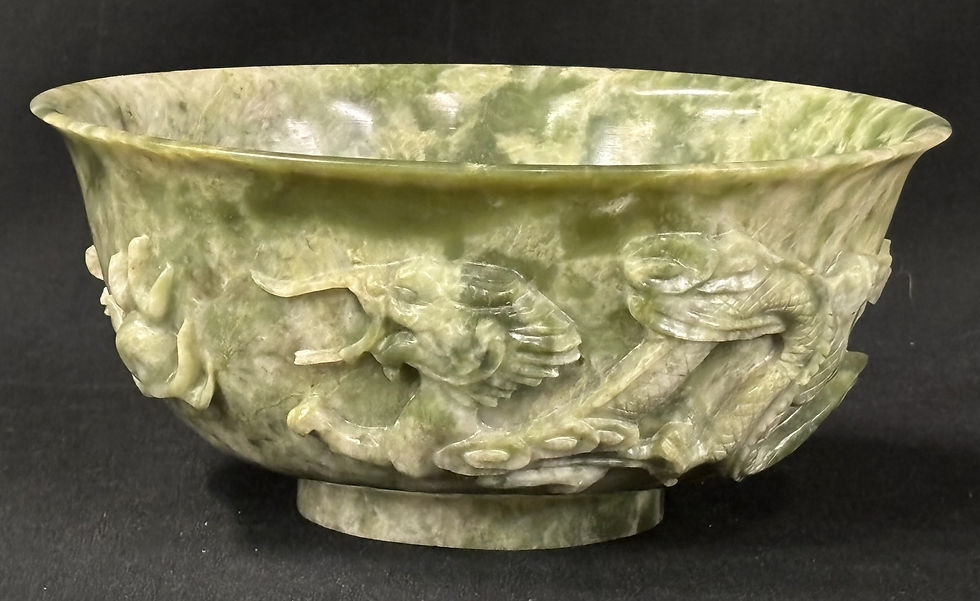
Dragons can represent power, prosperity, and good luck. There are many different kinds of dragons with different powers and attributes. Legends about Chinese dragons date back to 3000BC. In mythology, dragons can live in the sky, land, or sea. Dragons can even control the weather!
Even the color of the dragon has meaning. The white dragon can represent purity or death. The red dragon represents good luck and happiness. The yellow dragon is seen as a sign of wealth and wisdom. The black dragon brings vengeance.
Most dragons in Chinese mythology do not have wings, but a few do. If they have wings, be careful, as they often bring rain.
In the Near East, there were depictions of dragons as early as the ancient Babylonians. Dragons appeared in Greek and Roman art and literature.
The idea of dragons protecting treasure is very old. Some historians say it dates back to

the Greek and Roman stories. In fact, our ivory jewelry box, which dates to the 16th century, has a dragon’s head protecting the lock and a dragon on top of the box. European dragons, unlike Chinese ones, are often depicted with wings.
In the Middle Ages, several Christian saints had interactions with dragons with St. George and the dragon being the most famous. St. George was a Roman soldier who was martyred in the third or fourth century BC. In the Medieval stories, St. George arrived at the city of Silene, where a dragon was terrorizing the town. The townspeople tried to satiate the dragon by giving him sheep, but eventually, he wanted more. People were then sacrificed to the dragon. Thankfully, George arrived and slew the dragon and saved the rest of the town. By the fourteenth century, St. George became a patron saint of England thanks to King Edward III.

But it wasn’t just the male saints who had conflicts with dragons. Both St. Margret of Antioch and St. Martha vanquished dragons. St. Margret was swallowed by the devil in the form of a dragon. He burst out of the dragon unharmed, holding a cross. St. Martha tamed a dragon that was terrorizing a town in France using holy water and a crucifix.
Art Project
For instructions and videos on this and more art projects with dragons, visit mgmoa.org/art-projects
Toilet Roll Dragon
Supplies: toilet paper rolls, paint, paintbrushes, pom-poms, googly eyes, tissue paper
Paint the toilet paper roll.
Once dry, glue on two pom-poms for the eyes and two for the nostrils of the nose.
Glue some tissue paper inside the toilet roll coming out for the fire that the dragon is breathing.
Glue googly eyes onto the top pom-poms for the eyes.


Comments