George Inness
- MGMoA

- Jun 23
- 2 min read
by Delaynna Trim, Mabee-Gerrer Museum of Art Curator
May 1 marked the 200th anniversary of artist George Inness’s birth. You might

recognize Evening on the Farm from the Mabee-Gerrer Museum of Art’s gallery. This painting was conserved in the 1990s, which helped brighten it as well as fix water damage from a leaking roof. Like many of Inness’ works, it is in soft focus. We can still differentiate the woman carrying a bundle with a house and cows in the distance. Evening on the Farm was donated to the museum by W. B. and Grace Davis in 1987.
On May 1, 1825, George Inness was born in Newburgh, New York. He was the fifth of 13 children. In 1839, he started studying with a traveling painter, John Jesse Barker. Later, he worked as a map engraver for Sherwin and Smith and then N. Currier (later Currier & Ives). He apprenticed with French landscape painter Régis François Gignoux. George also studied at the National Academy of Design.
He opened his first studio in New York in 1848. A year later, he married Delia Miller,

who unfortunately died only a few months after their wedding. In 1850, he married Elizabeth Abigail Hart, and they had six children together. In 1851, he went to Rome and Florence to study art. This was his first international trip. In 1853, he was elected to the National Academy of Design as an Associate member and became a full Academician in 1868. During the 1850s, he traveled to Paris many times and was influenced by the Barbizon school, whose artists were known for their looser brushstrokes and darker palette.
In 1860, George and his family moved to Medford, Massachusetts. By 1877, he had moved to Tarpon Springs, Florida, only to move to Montclair, New Jersey, in 1885. During his last decade, he visited the Adirondacks, Niagara Falls, Nantucket, Virginia, Georgia, Chicago, California, Montreal, and England. Inness died in 1894 at Bridge of Allan in Scotland. According to his son, he was viewing the sunset, when he threw up his hands into the air and exclaimed, "My God! Oh, how beautiful!", fell to the ground, and died minutes later.
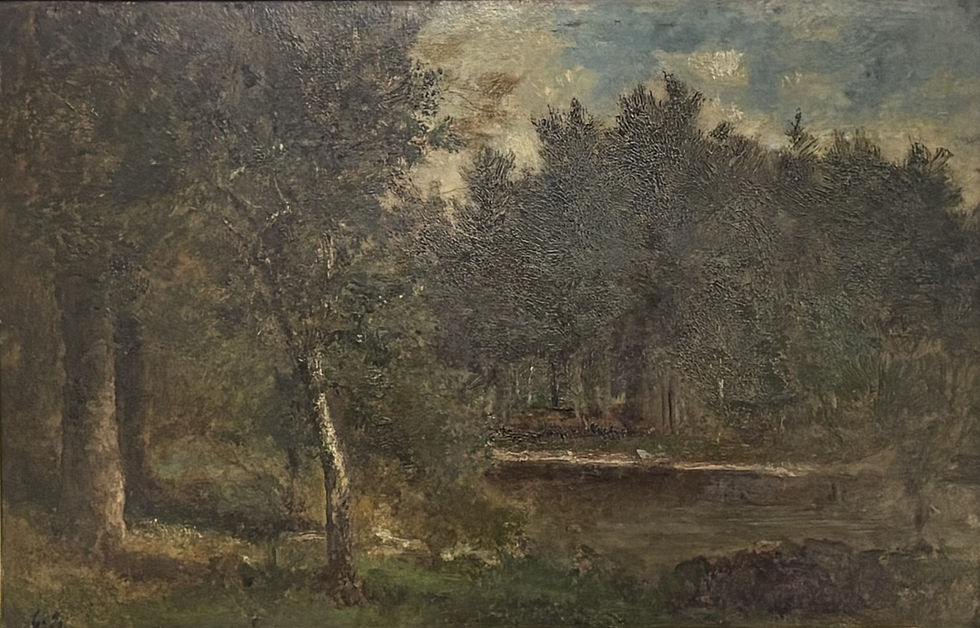
The MGMoA has another Inness painting and even one of his palettes. The second painting, Woodland Scene, features trees surrounding a pond. You can see that the dark colors he used take up much of the palette.
He created over 1,150 paintings, watercolors, and sketches. Most of his works are landscapes as he wanted to capture the beauty of nature. His works are included in the collections of the Art Institute of Chicago, the National Gallery in Washington, D.C., the Musée d'Orsay in Paris, and the Metropolitan Museum of Art in New York, among others.
Silhouette Painting
For videos on silhouette painting and other similar projects, check out: www.mgmoa.org/art-projects
Supplies: paint or crayons, paper
Paint the background using multiple colors. For example, you can paint like a sunset, starting with red at the top and continuing with orange, then yellow as you come down the paper. You can also start with a blue sky and go from there.
Now start drawing the ground, trees, and buildings using black or dark brown.
Be creative!


Comments